
How Groundbreaking Research on the Brain’s Ability to Grow New Neurons Is Rewriting the Playbook on Cognitive Aging — and Why Neurofeedback Deserves a Seat at the Table
Published February 2026 | Hippocampus Labs
A Discovery That Changes Everything We Thought About Aging
For decades, the scientific consensus was clear: the adult brain does not grow new neurons, aging meant decline, and memory loss was inevitable. The hippocampus is the brain’s memory center, and it was destined to shrink, and with it, our cognitive sharpness. That consensus just shattered.
On February 25, 2026, a landmark study published in Nature by researchers at the University of Illinois Chicago and Northwestern University delivered extraordinary evidence: the adult human brain continues to produce new neurons well into old age, and some individuals produce far more than others.
The study, titled “Human hippocampal neurogenesis in adulthood, ageing and Alzheimer’s disease,” analyzed approximately 356,000 individual cell nuclei from the hippocampus of 63 individuals ranging from young adults to those in their nineties. Using advanced single-nucleus RNA sequencing, the researchers mapped the cellular landscape of the hippocampus with unprecedented precision.
What they found was remarkable.
The SuperAger Advantage: 2–2.5x More New Neurons
The study identified a group of individuals known as SuperAgers, people over 80 whose memory performance rivals that of individuals 20 to 30 years younger. These cognitive outliers aren’t just aging well. Their brains are doing something measurably different.
SuperAgers were found to produce two to two-and-a-half times more new neurons in the hippocampus compared to their age-matched peers. Even more striking, their rate of neurogenesis was comparable to that of individuals decades younger.
The researchers identified what they called a “resilience signature”, a distinct cellular profile in the SuperAger hippocampus characterized by robust populations of astrocytes and CA1 neurons, the very cells responsible for memory encoding and retrieval.
In contrast, individuals with Alzheimer’s disease showed dramatically depleted neurogenesis and disrupted cellular architecture in the same regions.
The implication is profound: cognitive aging is not simply a matter of time. It is, at least in part, a matter of neurobiological activity that can vary dramatically between individuals.
KEY FINDING
SuperAgers produce 2–2.5x more new neurons in the hippocampus than typical older adults. Their brains exhibit a “resilience signature” that protects cognitive function into the ninth decade of life and beyond.
The Critical Question: Can We Influence Neurogenesis?
This is where the discovery becomes actionable. If neurogenesis in the hippocampus is the distinguishing feature of SuperAgers, the next question is obvious: can we do anything to support, protect, or enhance this process?
The answer, emerging from a growing body of peer-reviewed research, is yes, and neurofeedback may be one of the most promising tools available.
The Neurofeedback–Neuroplasticity Connection
Neurofeedback is a non-invasive brain training technique that uses real-time EEG monitoring to help the brain learn more efficient patterns of electrical activity. By providing the brain with feedback about its own function, neurofeedback supports the process of neuroplasticity — the brain’s ability to reorganize, adapt, and form new neural connections.
While neurofeedback does not directly “create” new neurons, the scientific literature suggests it activates and supports the very biological pathways that underlie neurogenesis and neural resilience.
Neurofeedback and BDNF: Fuel for New Neurons
A 2019 review by Berman and Nichols published in Photobiomodulation, Photomedicine, and Laser Surgery examined the neurobiological mechanisms behind neurofeedback’s clinical effects. The authors reported that neurofeedback training is associated with increased brain-derived neurotrophic factor (BDNF) mRNA expression and increased dendrite production and density in the hippocampus (PMID: 31647776).
BDNF is often called “fertilizer for the brain.” It is one of the primary molecules that support the growth, survival, and differentiation of new neurons. The fact that neurofeedback has been shown to upregulate BDNF expression in the hippocampus, the exact region where SuperAgers show enhanced neurogenesis, is a finding of extraordinary relevance.
Direct Hippocampal Engagement During Neurofeedback
Research by Quevedo and colleagues (2019), published in Developmental Cognitive Neuroscience, used functional neuroimaging to demonstrate that neurofeedback training directly engages the hippocampus and amygdala, two structures central to memory formation and emotional regulation (PMID: 31733523).
This is not peripheral or indirect activation. Neurofeedback, when guided by accurate brain mapping data, produces measurable changes in the very neural structures that the Nature study identifies as critical to cognitive resilience.
Neurofeedback for Cognitive Aging and Mild Cognitive Impairment
A 2025 study by Houmani and colleagues, published in Scientific Reports, demonstrated that gamma-frequency neurofeedback training promotes healthy brain aging by enhancing neural oscillatory patterns associated with cognitive flexibility and attention (PMID: 41350343).
Su and colleagues (2021), in Frontiers in Aging Neuroscience, showed that neurofeedback training contributed to cognitive functional recovery in individuals with mild cognitive impairment (MCI) — a condition often considered a precursor to Alzheimer’s disease (PMID: 34393752). Participants showed improvements in working memory, attention, and executive function.
Additionally, Jiang and colleagues (2022) reviewed neurofeedback paradigms specifically targeting working memory decline in aging populations, concluding that neurofeedback represents a viable, non-pharmacological intervention for age-related cognitive decline (PMID: 35418848).
Connecting the Dots: A Framework for Brain Resilience
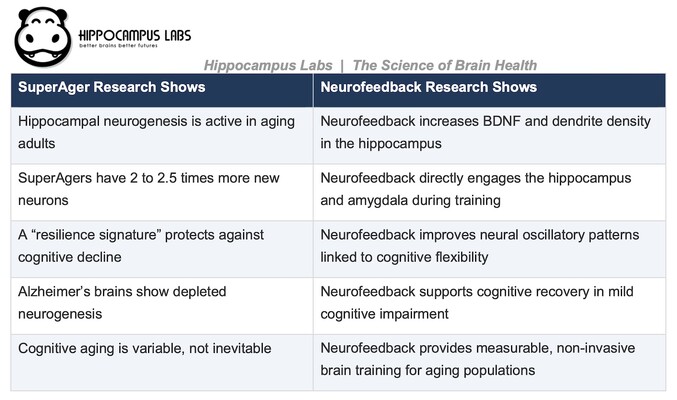
When we integrate the SuperAger findings with the neurofeedback research, a compelling framework emerges:

The convergence is striking. The very mechanisms that distinguish SuperAgers from typical aging, robust hippocampal neurogenesis, BDNF activity, neural resilience are the same mechanisms that neurofeedback has been shown to support and enhance.
The Stress Factor: Why Protection Matters as Much as Growth
It is not enough to promote neurogenesis. We must also protect the hippocampus from the forces that degrade it. Chief among these is chronic stress.
Decades of research have established that chronic psychological stress suppresses hippocampal neurogenesis, reduces hippocampal volume, and impairs memory and cognitive function. Elevated cortisol — the primary stress hormone — is directly neurotoxic to hippocampal neurons.
This creates a dual imperative: support neurogenesis while simultaneously reducing the neural stress load that undermines it.
Neurofeedback is uniquely positioned to address both sides of this equation. By training the brain toward more regulated patterns of electrical activity, neurofeedback reduces the hyperarousal and dysregulation associated with chronic stress. Research consistently shows that neurofeedback training improves heart rate variability, reduces cortisol reactivity, and promotes parasympathetic tone — all markers of reduced physiological stress.
In other words, neurofeedback may not only help the brain grow new neurons — it may help protect the ones it already has.
Hippocampus Labs: Precision Neurofeedback Built for This Moment
The SuperAger research underscores a truth that Hippocampus Labs has built its entire clinical model around: the hippocampus is the center of cognitive health, and supporting its function should be a clinical priority.
Hippocampus Labs provides a turnkey, clinic-ready neurofeedback system designed for healthcare practices that want to offer advanced brain health services with clinical rigor and measurable outcomes. The system is built on three pillars:
1. qEEG Brain Mapping: Objective Measurement
Every engagement begins with a quantitative electroencephalogram (qEEG) a comprehensive assessment of brain electrical activity. This provides an objective, data-driven baseline that reveals areas of dysregulation, inefficiency, or imbalance. Unlike symptom-based approaches, qEEG brain mapping allows clinicians to see what is happening in the brain and design interventions accordingly.
2. Individualized Neurofeedback Protocols: Precision Training
Based on qEEG findings, Hippocampus Labs’ team of neuroscientists designs individualized neurofeedback protocols tailored to each patient’s unique neural profile. These are not generic, one-size-fits-all programs. Each protocol is expert-interpreted, continuously refined, and built on a safety-first philosophy that prioritizes stabilization before stimulation.
3. Ongoing Optimization: Adaptive, Measurable Progress
Progress is monitored throughout the training process, with protocols adjusted as the brain changes. This adaptive approach ensures that training remains targeted and effective, producing sustainable functional improvements rather than temporary symptom relief.
WHY “HIPPOCAMPUS” LABS?
The company’s name is no coincidence. The hippocampus is the brain’s memory formation center and the epicenter of neurogenesis research. The SuperAger study confirms what Hippocampus Labs has always believed: that the hippocampus holds the key to cognitive resilience — and that with the right tools, we can support its function at any age.
What This Means for Healthcare Providers and Their Patients
The SuperAger discovery is not an abstraction. It has immediate, practical implications for clinicians and the patients they serve:
Cognitive aging is not a passive process. The brain continues to produce new neurons into the latest decades of life. This means that interventions targeting brain health are relevant and potentially impactful at any age.
The hippocampus is modifiable. Neurogenesis, BDNF expression, and neural resilience are not fixed traits. They are influenced by environment, stress, and critically by targeted brain training.
Neurofeedback has a growing evidence base. Peer-reviewed research demonstrates that neurofeedback engages the hippocampus, supports BDNF production, and improves cognitive outcomes in aging populations.
Patients are looking for proactive solutions. As awareness of brain health grows, patients increasingly seek non-invasive, data-driven approaches to cognitive wellness. Neurofeedback meets this demand.
The Future of Brain Health Is Here
The Nature study on SuperAgers is a watershed moment in neuroscience. It tells us that the brain’s capacity for renewal is far greater than we imagined — and that some individuals have found a way to maintain that capacity into advanced age.
The question is no longer whether the brain can grow new neurons. The question is what we do with that knowledge.
At Hippocampus Labs, the answer is clear: we use precision neurofeedback, guided by qEEG brain mapping and designed by neuroscientists, to give the brain the best possible conditions to thrive. Not to replace medical care. Not to make promises beyond the evidence. But to offer a scientifically grounded, clinically rigorous tool that supports the brain’s own remarkable capacity for resilience and renewal.
Because if the SuperAgers have taught us anything, it’s this: the brain that keeps growing is the brain that keeps remembering.
References
1. University of Illinois Chicago & Northwestern University. “Human hippocampal neurogenesis in adulthood, ageing and Alzheimer’s disease.” Nature (2026). DOI: 10.1038/s41586-026-10169-4
2. Berman MH, Nichols JA. “Photobiomodulation with near infrared light helmet in a pilot, placebo controlled clinical trial in dementia patients testing memory and cognition.” Photobiomodulation, Photomedicine, and Laser Surgery (2019). PMID: 31647776
3. Quevedo K, et al. “Neurofeedback and neuroplasticity of visual self-processing in depressed and healthy adolescents.” Developmental Cognitive Neuroscience (2019). PMID: 31733523
4. Houmani N, et al. “Gamma neurofeedback promotes healthy brain aging.” Scientific Reports (2025). PMID: 41350343
5. Su X, et al. “Neurofeedback training contributes to the maintenance of brain cognitive function for individuals with mild cognitive impairment.” Frontiers in Aging Neuroscience (2021). PMID: 34393752
6. Jiang Y, et al. “Neurofeedback paradigms to improve working memory performance in aging populations.” Frontiers in Aging Neuroscience (2022). PMID: 35418848
Disclaimer
This article is provided for educational and informational purposes only. It does not constitute medical advice, diagnosis, or treatment. Neurofeedback should be administered under the guidance of qualified healthcare professionals. Individual results may vary. The research cited herein represents current scientific understanding and should not be interpreted as guaranteeing specific clinical outcomes.
© 2026 Hippocampus Labs